
Putnam Projected Versus Actual Release
A projected date is a planning point based on the information then in force. It can be a sentence-completion estimate, a maximum date, or parole timing. The actual release is the event recorded after staff process the order, check warrants and holds, settle the custody destination, and let the person leave or transfer them. Those two dates can differ without either record being false.
A Putnam County Jail detainee awaiting trial has no ordinary sentence-based release date. Bond can be posted, changed, denied, or delayed by another hold. A sentenced person has a court judgment, but jail credit or another order may affect the calculation. State prisoners have GDC and Parole Board records. Never apply a state-prison date or credit rule to a local jail booking.
Find a Putnam Release Date
Begin with the place that holds the person now. A missing name from a local source can mean transfer rather than release. Keep the booking, case, or offender number when possible because it separates people with similar names and links the custody record to the court sentence.
- For Putnam County Jail, call 706-485-2680 and ask which records channel handles release timing.
- Search the Putnam County Clerk docket for bond, sentence, jail credit, dismissal, revocation, or transfer orders.
- For state prison, accept the GDC offender-search disclaimer and search by name, ID, case number, age, or other facts.
- Read the GDC status, sentence begin date, maximum date, facility, and release or discharge data actually displayed.
- For parole timing, check the Parole Board TPM explanation and person-specific lookup.
- Confirm a same-day local event with the jail and a state event with GDC or the Parole Board.
The Putnam County search and release-record guide gives the full records-request path when an online result is too thin.
GDC Putnam Sentence Fields
The GDC offender search applies when the person entered Georgia state-prison custody or has a state corrections history. It does not confirm an ordinary Putnam County bond release. GDC warns that its public index may be incomplete and directs users who need verification to Inmate Records and Information, P.O. Box 1529, Forsyth, GA 31029.
| Record item | How to read it |
|---|---|
| Status and facility | Shows the state custody setting or released/discharged state, when supplied. |
| Sentence begin date | Marks the sentence timeline, not a promise of release. |
| Maximum date | May identify sentence completion if no earlier lawful release occurs. |
| Offense and conviction county | Help match the correct case and identify statutory limits. |
| Release or discharge date | Documents a completed state event when shown. |
| GDC ID | Connects the offender record to TPM and written inquiries. |
Capture exact labels from the live person record. Dynamic public fields can vary, and a date shown for one offender should not be assumed to exist for every record.
Georgia TPM Is Tentative
The Georgia Parole Board TPM page defines TPM as Tentative Parole Month. It is the month in which the Board expects to complete final review and, if appropriate, establish a parole release date. It is not a grant of parole and is not the same as the day a person will walk out.
The lookup can use a six-digit inmate number, GDC ID, or personal data. A TPM may depend on good conduct and completion of required drug, alcohol, treatment, or other programming. The Board can reconsider its decision up to release. If the inmate is not parole eligible, the maximum or sentence-completion date may be the more useful state date.
The manifest image below comes from the Board’s official explanation.
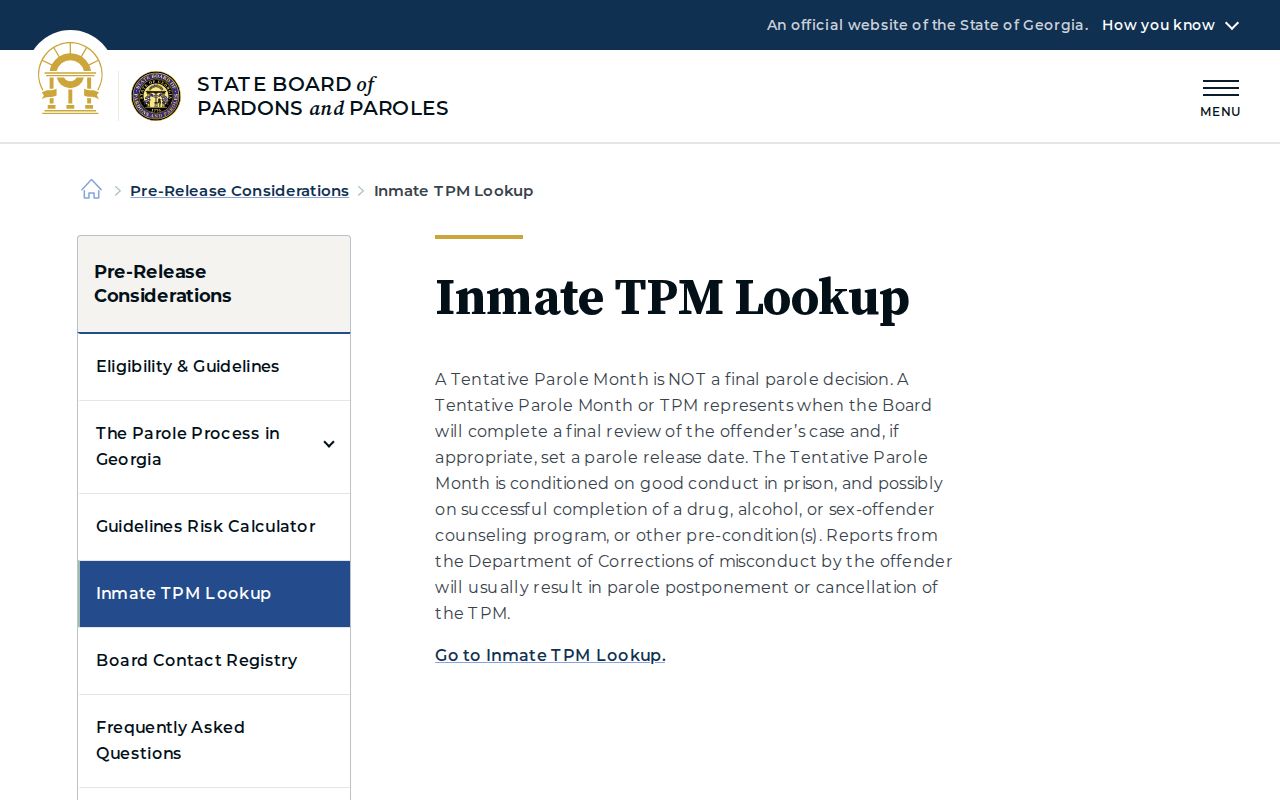
That distinction is central to every Putnam County state-prison date inquiry.
Georgia Parole Eligibility Rules
O.C.G.A. Section 42-9-45 supplies baseline eligibility rules, not guaranteed release dates. A misdemeanor sentence is generally eligible for consideration after six months or one-third of the sentence, whichever is greater. A felony sentence is generally eligible after nine months or one-third, whichever is greater, subject to exceptions. Long aggregate sentences, recidivist provisions, offense dates, and other statutes can change the result.
Georgia has no universal rule that every prisoner must serve 85 percent. O.C.G.A. Section 17-10-6.1 makes some serious violent felony term-of-years sentences ineligible for parole. Parole guidelines under O.C.G.A. Section 42-9-40 and state rule 475-3-.05 assess offense severity, risk, conduct, and other factors. High guideline percentages are recommendations within that system, not a flat statewide formula.
Eligibility means the Board may consider the case. It does not mean parole will be granted at the first possible point. The Board’s process page states that few eligible inmates are granted parole at initial eligibility.
Performance Credit Changes State Timing
GDC’s Performance Incentive Credit page describes PIC as an incentive reentry process for eligible state offenders. Satisfactory progress in education, vocational work, treatment, work assignments, cognitive programs, and good behavior can affect length of stay. Credit is not automatic and does not apply to all offenders.
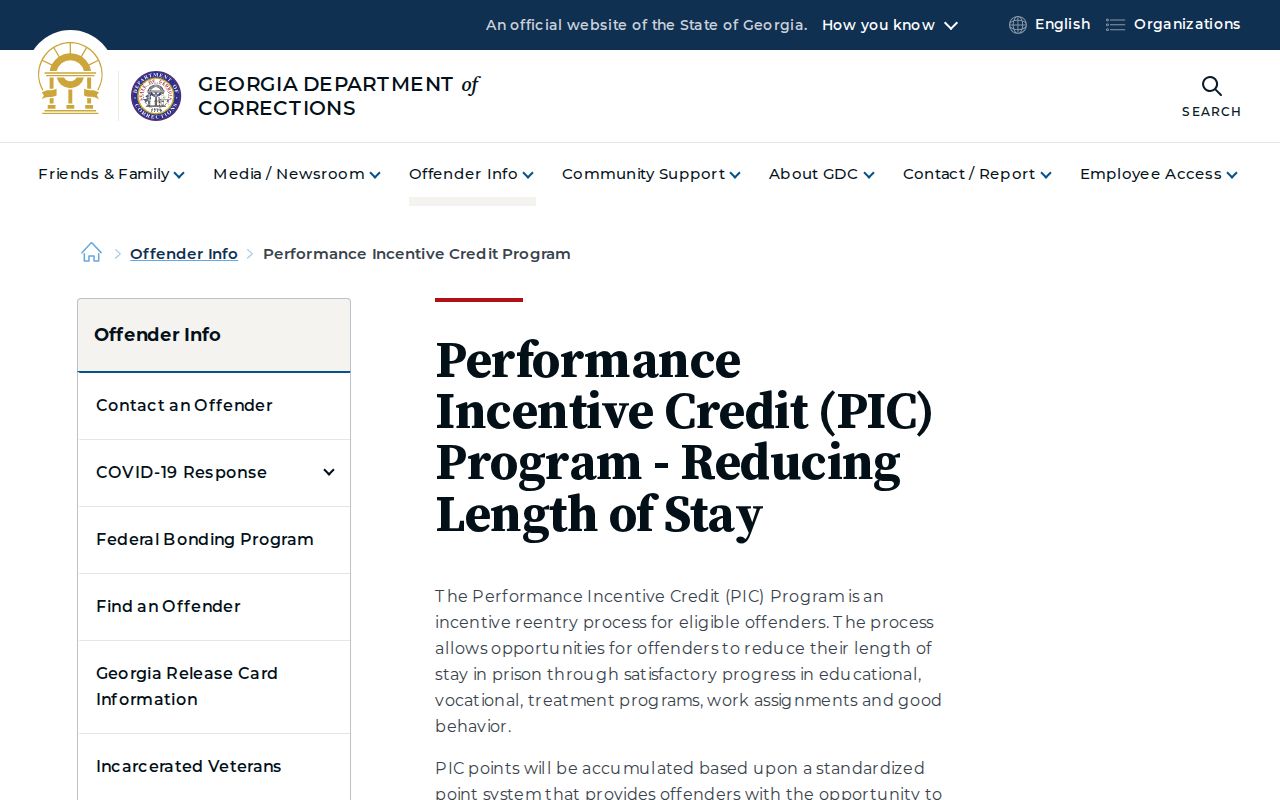
PIC is not a Putnam County Jail good-time formula. The sheriff’s public material does not publish a local good-time policy or jail sentence calculator. Local jail timing must be verified through the jail and sentencing court.
Why Putnam Release Dates Move
A date may change because the legal or custody facts change. The source of the date determines which office can explain the change.
| Factor | Possible effect |
|---|---|
| Bond posted or modified | Can permit an earlier local release after processing. |
| New warrant or detainer | Can block community release or send the person to another agency. |
| Court order or correction | Can alter sentence, credit, bond, or release authority. |
| GDC conduct and programming | Can affect PIC eligibility or parole review conditions. |
| Parole decision | Can set, delay, deny, rescind, or reconsider state release timing. |
| Transfer to GDC | Ends Putnam jail custody but begins a state custody timeline. |
| Processing lag | Can place the actual release after an order or status update. |
A VINE alert may also lag the agency event. Use it as notice, then confirm the actual day and reason with the office that held the person.
Confirm Putnam Actual Release
For a local event, ask the sheriff for the booking sheet, release date and time, release reason, and receiving agency when relevant. The records form can be sent to records@putnamcountysheriff.org, faxed to 706-485-4840, or mailed to the sheriff’s records office at P.O. Box 3637, Eatonton, GA 31024. The court docket can confirm the order behind the event.
For state custody, compare GDC status with TPM or Parole Board information. After release on parole, the Parolee Search and DCS address supervision, not the original jail release. A person released from jail on probation may never enter state prison. To watch for a pending custody change, use the Putnam County VINE inmate check, then seek the official record.
Putnam Sentences Need Source Records
A Putnam County sentence must be matched to the correct offense and sentencing order before any rule is applied. The conviction date and offense class can change which law governs. A public result may not display each fact used in the official calculation. When dates conflict, obtain the judgment from the clerk and ask GDC or the Parole Board to explain its record instead of computing a new date from a docket summary.
Jail credit is case-specific. Time already served may affect a sentence, but the sheriff does not publish a calculator. An estimate that ignores credited time, concurrent or consecutive terms, or a later court order can be wrong even when the basic sentence length is known.
Putnam Jail Has No Formula
The sheriff’s public jail material does not state a local good-time schedule, weekend-release rule, or sentence-credit calculator. A county sentence should not be estimated with GDC Performance Incentive Credit, parole guidelines, or a formula borrowed from another county. The sentencing order, credited time, and jail calculation control the local date.
For a pretrial person, ask about bond and holds. For a misdemeanor sentence, request the judgment and confirm credit with the jail or court. For a person leaving Putnam custody for state prison, record the transfer date and begin a separate GDC inquiry. The transfer is not final discharge.
Same-day timing deserves a final check. A judge may sign an order before the jail receives or processes it. A VINE notice can follow the agency update, and another hold may redirect the person. Ask for the actual release timestamp and release type after processing is complete.
Public Record Search
Sponsored Results